Understanding AI and Machine Learning: The Technology Powering Tomorrow
What is Artificial Intelligence (AI)?
Artificial Intelligence (AI) refers to the development of computer systems that can perform tasks that typically require human intelligence. These tasks include understanding natural language, recognizing patterns, making decisions, solving problems, and learning from experience. AI aims to mimic cognitive functions such as perception, reasoning, knowledge representation, planning, and creativity.
At its core, AI is not a single technology but a broad field encompassing various sub-disciplines. It draws from computer science, mathematics, psychology, linguistics, and neuroscience. The concept of AI dates back to the 1950s, with pioneers like Alan Turing posing the question, “Can machines think?” in his seminal paper Computing Machinery and Intelligence (1950). Modern AI has evolved dramatically due to advancements in computing power, data availability, and algorithms.
Key Components of AI
AI systems generally consist of:
- Data: The fuel for AI. Massive datasets are used to train models.
- Algorithms: Sets of rules or procedures that process data to achieve outcomes.
- Hardware: Specialized processors like GPUs (Graphics Processing Units) for handling complex computations.
- Software Frameworks: Tools like TensorFlow or PyTorch that enable building and deploying AI models.
Types of AI
AI can be categorized based on capability and functionality:
- Narrow AI (Weak AI): Designed for specific tasks. Most current AI falls here. It excels in one area but lacks general understanding.
- General AI (Strong AI): Hypothetical AI that can understand, learn, and apply intelligence across any intellectual task a human can do. This doesn’t exist yet.
- Super AI: Even more advanced, surpassing human intelligence in all aspects—still theoretical and a topic of ethical debate.
AI can also be classified by approach:
- Rule-Based AI: Uses predefined rules (e.g., if-then statements) without learning from data.
- Machine Learning-Based AI: Learns from data (more on this below).
- Other Subfields: Includes natural language processing (NLP), computer vision, robotics, and expert systems.
How AI Works: A High-Level Overview
AI systems process inputs through layers of computation:
- Perception: Gathering data via sensors, cameras, or text inputs.
- Reasoning: Analyzing data using logic or probabilistic models.
- Learning: Adjusting internal parameters based on feedback to improve accuracy.
- Action: Outputting decisions, predictions, or responses.
For instance, in a neural network (a common AI architecture inspired by the human brain), data flows through interconnected nodes (neurons) in layers. Each node applies weights and biases to inputs, and the network “learns” by minimizing errors through techniques like backpropagation.
Real-World Examples of AI
To illustrate, here are some in-depth examples of AI in action:
- Virtual Assistants (e.g., Siri by Apple or Google Assistant):
- How it Works: These use NLP to understand spoken queries, machine learning to personalize responses, and integration with other AI subsystems like speech recognition and knowledge graphs.
- In-Depth Process: When you ask, “What’s the weather in Pune?”, the system transcribes your speech using acoustic models, parses the intent via semantic analysis, queries a weather API, and synthesizes a spoken response. Over time, it learns your preferences (e.g., metric vs. imperial units) from interaction data.
- Impact: Handles billions of queries daily, improving efficiency in daily tasks. In 2023, Siri processed over 20 billion requests monthly, demonstrating scalable AI deployment.
- Challenges: Privacy concerns (data collection) and occasional misunderstandings in accents or context.
- Autonomous Vehicles (e.g., Tesla’s Autopilot):
- How it Works: Combines computer vision (to detect objects), sensor fusion (from LIDAR, radar, cameras), and decision-making algorithms to navigate roads.
- In-Depth Process: The AI processes real-time data streams—e.g., identifying a pedestrian via convolutional neural networks (CNNs), predicting trajectories with reinforcement learning, and planning paths using optimization algorithms. Tesla’s system uses a “fleet learning” approach, where data from millions of miles driven refines the model globally.
- Impact: Reduces human error in driving; Tesla reported over 10 billion miles of Autopilot data by 2024, leading to safer roads in controlled scenarios.
- Challenges: Ethical dilemmas (e.g., trolley problem in crash avoidance) and regulatory hurdles, as seen in investigations after rare accidents.
- Healthcare Diagnostics (e.g., IBM Watson Health for Oncology):
- How it Works: Analyzes medical images, patient records, and research papers to suggest diagnoses or treatments.
- In-Depth Process: Using deep learning, it scans CT images for tumors via pattern recognition, cross-references with vast databases (e.g., millions of cancer cases), and ranks treatment options based on survival rates and side effects. It employs ensemble methods (combining multiple models) for higher accuracy.
- Impact: Speeds up diagnosis; in trials, Watson matched oncologists’ recommendations 90% of the time, potentially saving lives in resource-limited areas like rural India.
- Challenges: Data bias (if trained on non-diverse datasets) can lead to inaccurate results for underrepresented groups.
What is Machine Learning (ML)?
Machine Learning (ML) is a subset of AI focused on building systems that learn from data rather than being explicitly programmed. Instead of hard-coding rules, ML algorithms identify patterns in data and make predictions or decisions. ML powers much of modern AI and has exploded in popularity since the 2010s due to big data and cloud computing.
The key idea: ML models improve with more data and experience, much like humans learn from examples. Arthur Samuel coined the term in 1959 while working on a checkers-playing program that improved through self-play.
Key Components of ML
- Training Data: Labeled or unlabeled datasets used to teach the model.
- Features: Variables or attributes in the data (e.g., pixel values in an image).
- Model: The mathematical structure (e.g., decision tree, neural network) that learns relationships.
- Evaluation: Metrics like accuracy, precision, recall to measure performance.
- Deployment: Integrating the model into applications for real-time use.
Types of ML
ML is broadly divided into:
- Supervised Learning: The model learns from labeled data (input-output pairs). Examples: Regression (predicting continuous values like house prices) and Classification (categorizing emails as spam/not spam).
- Unsupervised Learning: Works with unlabeled data to find hidden patterns. Examples: Clustering (grouping similar customers) and Dimensionality Reduction (simplifying data while retaining info).
- Reinforcement Learning: The model learns by interacting with an environment, receiving rewards/penalties. Like training a dog with treats.
- Semi-Supervised and Self-Supervised: Hybrids using limited labels or generating labels from data itself.
- Deep Learning: A subset using multi-layered neural networks, excelling in complex tasks like image/speech recognition.
How ML Works: A Deeper Dive
The ML workflow:
- Data Collection and Preprocessing: Gather data, clean it (handle missing values, normalize), and split into training/validation/test sets.
- Model Training: Use algorithms to fit the model—e.g., in linear regression, minimize the cost function (error) via gradient descent.
- Hyperparameter Tuning: Adjust settings like learning rate to optimize.
- Inference: Apply the trained model to new data.
For example, in a neural network for image classification:
- Input: Pixel values.
- Hidden Layers: Extract features (edges, shapes).
- Output: Probability scores for classes (e.g., 95% cat, 5% dog).
- Learning: Adjust weights to reduce loss (difference between predicted and actual).
Real-World Examples of ML
Here are detailed examples emphasizing ML’s role:
- Recommendation Systems (e.g., Netflix’s Content Suggestions):
- How it Works: Uses collaborative filtering (supervised ML) to analyze viewing history, ratings, and similar users’ preferences.
- In-Depth Process: Algorithms like matrix factorization break down user-item interactions into latent factors (e.g., genre preferences). Deep learning models incorporate metadata (actors, directors) and real-time behavior. Netflix’s system processes petabytes of data, updating recommendations dynamically.
- Impact: Drives 80% of watched content on Netflix, boosting user retention. In 2023, it helped the platform retain over 230 million subscribers by personalizing experiences.
- Challenges: The “cold start” problem (new users/items with no data) and echo chambers (reinforcing biases).
- Fraud Detection (e.g., in Banking Apps like PayPal or HDFC Bank in India):
- How it Works: Employs anomaly detection (unsupervised ML) and classification models to flag suspicious transactions.
- In-Depth Process: Features include transaction amount, location, time, and user history. Random Forest or neural networks classify patterns—e.g., a sudden large transfer from a new device triggers an alert. Reinforcement learning can adapt to evolving fraud tactics.
- Impact: Prevents billions in losses; PayPal’s ML system blocks 99% of fraudulent attempts, processing 10 million transactions daily.
- Challenges: False positives (legitimate transactions flagged) and adversarial attacks where fraudsters game the system.
- Predictive Maintenance (e.g., in Manufacturing, like GE’s Jet Engines):
- How it Works: Uses time-series forecasting (supervised ML) on sensor data to predict equipment failures.
- In-Depth Process: Models like LSTM (Long Short-Term Memory) networks analyze vibration, temperature, and usage data. They learn normal patterns and detect deviations, scheduling maintenance proactively.
- Impact: Reduces downtime by 20-50%; GE saved airlines millions by predicting engine issues, avoiding costly breakdowns.
- Challenges: Requires high-quality sensor data and handling imbalanced datasets (failures are rare).
Relationship Between AI and ML
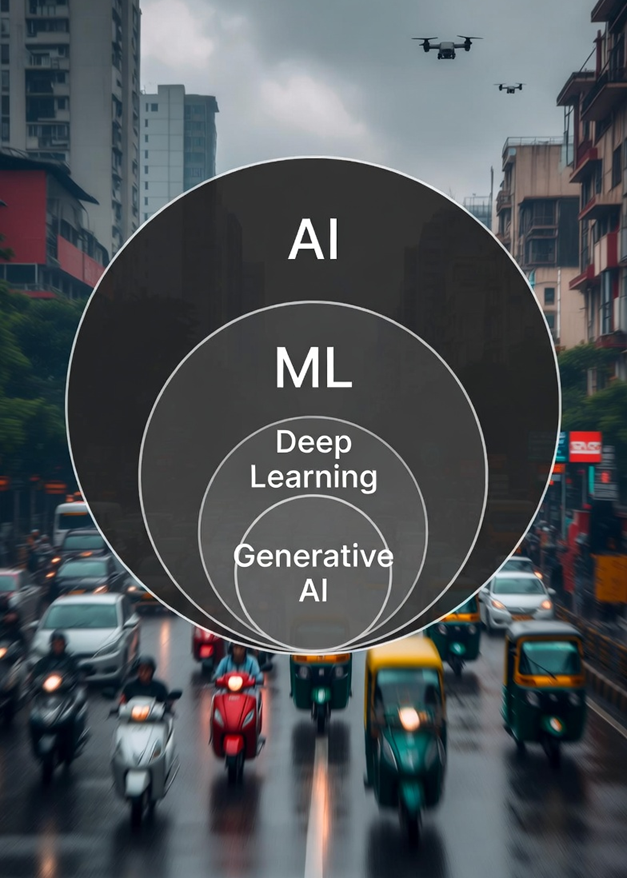
ML is a core enabler of AI—most advanced AI systems rely on ML for learning capabilities. However, not all AI is ML (e.g., rule-based expert systems). Deep learning is a subset of ML, and together they form the backbone of transformative technologies.
In summary, AI is the broader goal of intelligent machines, while ML provides the methods to achieve it through data-driven learning. As we advance toward 2030, ethical considerations like bias, job displacement, and AI safety (e.g., alignment with human values) will be crucial. If you’d like to dive into a specific subtopic, such as coding an ML model or ethical implications, let me know.
The main difference between AI (Artificial Intelligence) and ML (Machine Learning) is one of scope and relationship:
- AI is the broader, overarching goal/field — creating machines/systems that can perform tasks requiring human-like intelligence (reasoning, problem-solving, perception, decision-making, understanding language, etc.).
- ML is a specific subset/technique/method inside AI that enables systems to learn and improve automatically from data without being explicitly programmed for every rule or scenario.
In short:
All Machine Learning is AI, but not all AI is Machine Learning.
Classic Analogy (still the clearest in 2026)
Think of it like this:
- AI = the entire dream of building intelligent machines (the big umbrella / destination).
- Machine Learning = one very powerful way to reach parts of that dream (by letting machines learn patterns from examples/data instead of hard-coding every rule).
Other ways people describe it:
- AI is the brain trying to be smart like humans.
ML is how the brain learns from experience and data.
Quick Comparison Table (2026 perspective)
| Aspect | Artificial Intelligence (AI) | Machine Learning (ML) |
|---|---|---|
| Definition | Broad field: machines mimicking human intelligence | Subset of AI: algorithms that learn from data |
| Scope | Very wide — includes rule-based systems, robotics, expert systems, planning, etc. | Narrower — focused on learning & prediction from data |
| How it works | Can use rules, logic, search algorithms, knowledge bases, or learning methods | Primarily statistical/pattern-based learning from examples |
| Programming style | Can be explicitly programmed (if-then rules) | Minimal explicit programming — model learns patterns |
| Needs data? | Not always (classic/rule-based AI needs little/no data) | Almost always — data is the core fuel |
| Examples of non-ML AI | Chess programs using minimax search (Deep Blue), old expert systems, simple rule-based chatbots | — (these are AI but not ML) |
| Modern dominance | Today ~90%+ of impressive AI results come from ML/Deep Learning | The engine behind ChatGPT, image recognition, self-driving cars, recommendations, etc. |
| Goal | Simulate / achieve human-level (or superhuman) intelligence in tasks | Improve performance on a task through experience/data exposure |
Real-World Examples to Make It Crystal Clear
| System / Product | Is it AI? | Is it ML? | Explanation |
|---|---|---|---|
| ChatGPT / Grok / Gemini | Yes | Yes (heavily) | Built with deep learning (a type of ML) + large language models trained on massive data |
| Traditional chess program (e.g., early Deep Blue) | Yes | No | Used rule-based search algorithms + hand-crafted evaluation functions (classic AI, no learning from data) |
| Spam filter in Gmail (early versions) | Yes | Yes | Learned from labeled emails what is spam (ML technique) |
| Rule-based customer support bot that follows a decision tree script | Yes | No | Pure if-then rules — AI but not learning |
| Tesla Autopilot / Waymo | Yes | Yes (core) | Uses deep learning for vision, prediction, planning |
| Simple thermostat that turns on heat if temperature < 20°C | No | No | Just automation — not intelligent |
Quick Hierarchy (most accepted view in 2025–2026)
Artificial Intelligence (AI)
   └── Machine Learning (ML)
         └── Deep Learning (DL) ← uses multi-layer neural networks
               └── Generative AI / Large Language Models ← current hot subset of DL
Bottom line (one-sentence version):
AI is the big goal of making machines intelligent.
Machine Learning is the dominant modern method for achieving many of those intelligent behaviors by letting systems learn directly from huge amounts of data.